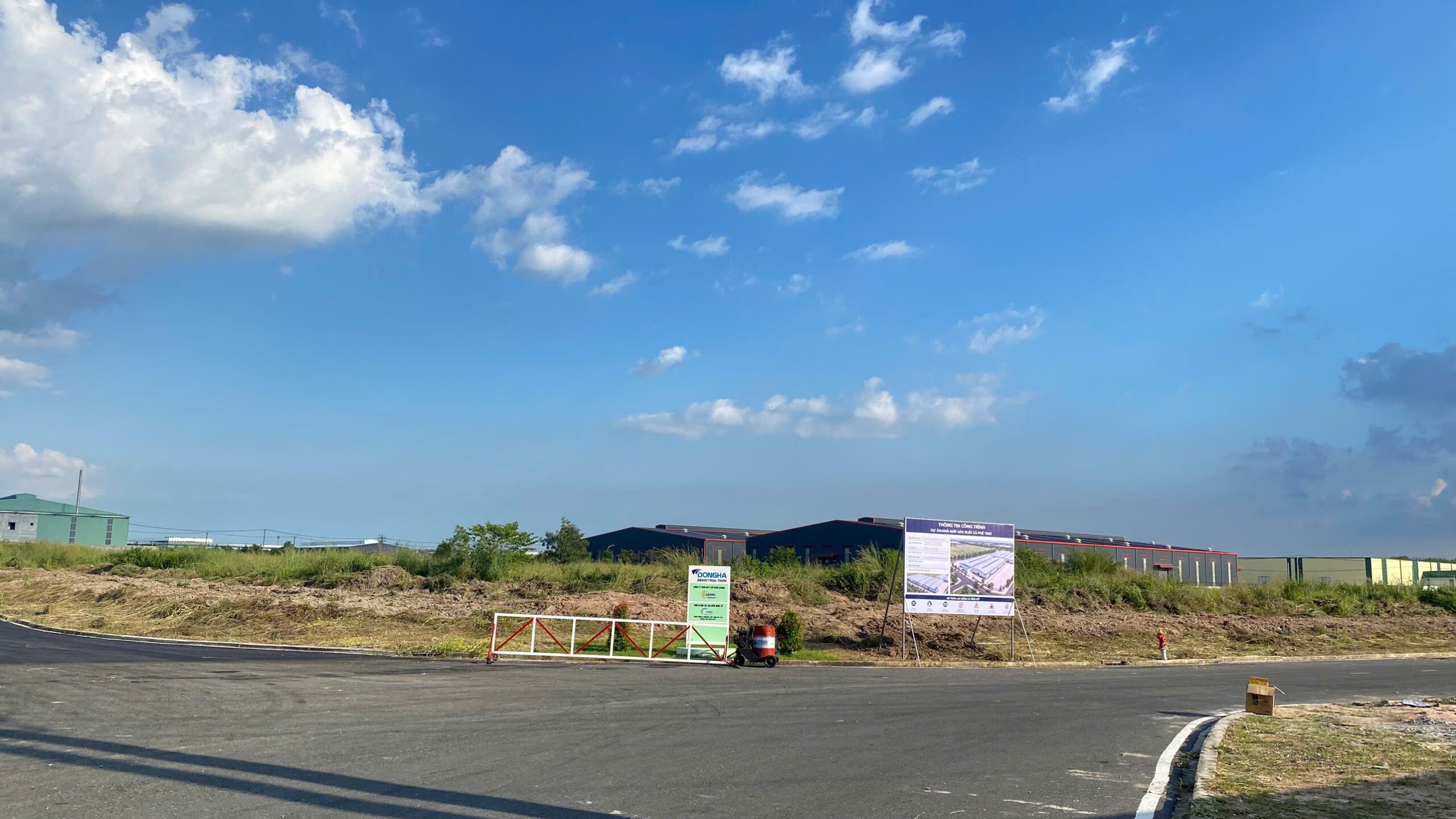
Amid the global wave of supply chain relocation, Vietnam continues to be a bright spot for FDI in manufacturing. For infrastructure developers and businesses looking for premises, one concept comes up often: the occupancy rate. So what is the industrial park occupancy rate, how is this indicator calculated, and how is it changing across Vietnam’s key economic regions in 2026? Let’s explore with Dong Ha below.
1. What is the industrial park occupancy rate?
Under Clause 12, Article 2 of Decree 82/2018/NĐ-CP, the industrial park occupancy rate is defined as follows: “The occupancy rate of an industrial park is the ratio of the industrial land area leased or sub-leased to investors for production and business activities to the total industrial land area of the industrial park, expressed as a percentage (%)”
The industrial park occupancy rate is the most visible “yardstick” of a project’s attractiveness, its ability to attract investment and how efficiently its land is used. The higher the rate, the greater the park’s competitive advantages in location, infrastructure and support policies.
See also: What is an eco-industrial park? Criteria for establishing an eco-industrial park

2. How to calculate the industrial park occupancy rate
Technically, the formula for this indicator is fairly clear. The area used in the calculation must be the commercial land available for lease (excluding land for roads, green space and shared technical infrastructure).
Formula for the industrial park occupancy rate:
Occupancy rate (%) = (Total industrial land area leased / Total leasable industrial land area) x 100
Example: An industrial park covers 300 ha, of which 200 ha is planned for lease for production. To date, the total land area under lease contracts with investors is 160 ha.
Applying the formula, the occupancy rate of this project is: (160 / 200) x 100 = 80%.
3. Industrial park occupancy rates in Vietnam in 2026
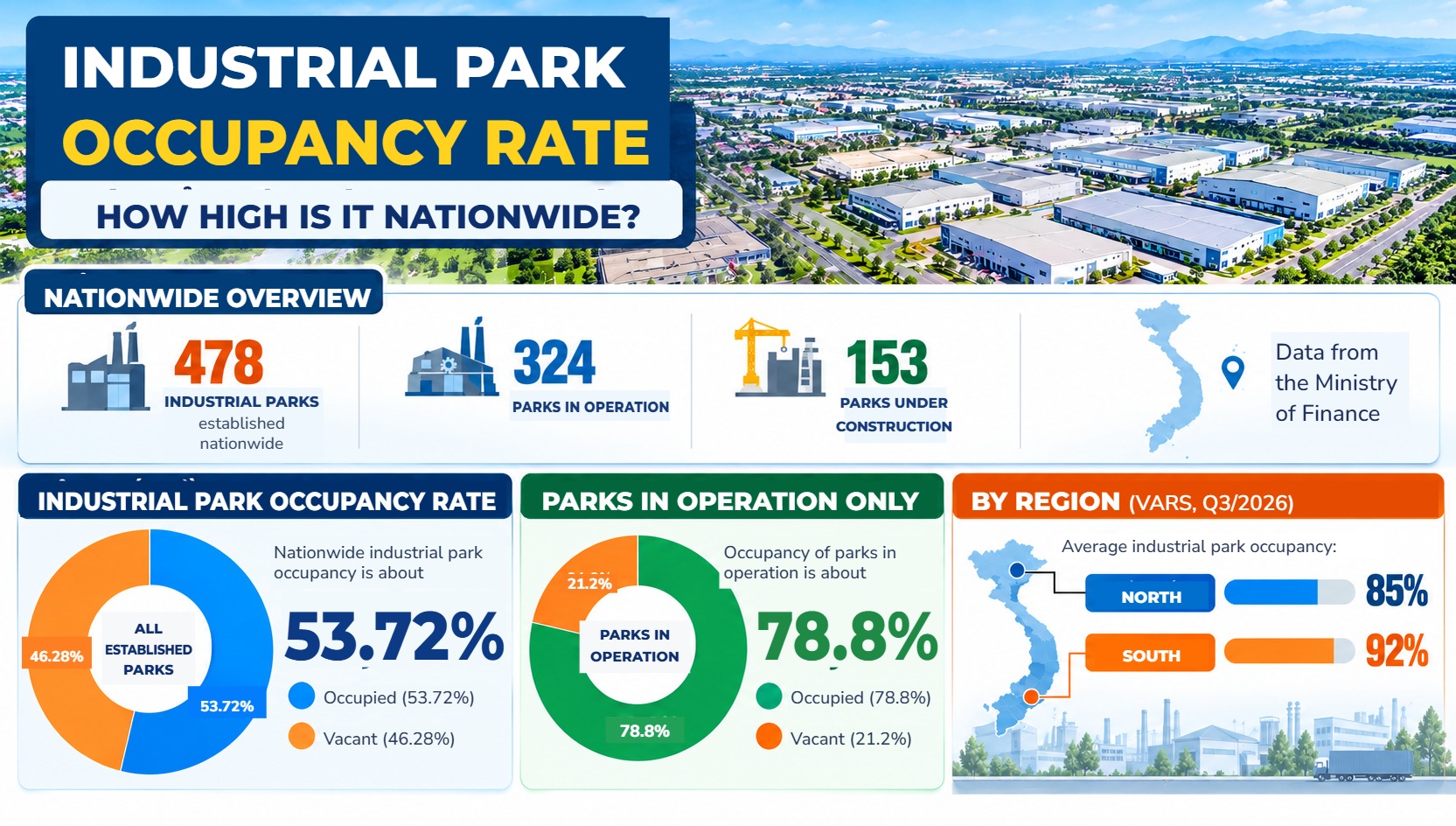
2026 has seen clear differentiation and the rise of high-quality FDI flows (semiconductors, high technology, green energy). This directly affects industrial park occupancy rates across all three regions. According to CBRE research as of Q1/2026, cited in Cong Thuong newspaper, occupancy rates vary between regions. Specifically:
3.1. Industrial park occupancy rate in the North
The North (especially industrial hubs such as Bac Ninh, Hai Phong, Quang Ninh and Hai Duong) continues to record impressive growth. Thanks to integrated transport links with China and a deep-water seaport system, the industrial park occupancy rate in these key provinces currently ranges 80%. Many newly operating parks meeting eco-industrial park (Eco-IP) standards have also quickly filled their phase 1 area thanks to the wave of investment in electronic components and semiconductors.

3.2. Industrial park occupancy rate in the South
In the South’s “industrial capital”, including Binh Duong, Dong Nai, Long An and Ba Ria – Vung Tau, clean land near rivers and roads is increasingly scarce. As a result, the occupancy rate of industrial parks here always stays very high, averaging 86%. The shortage of industrial land near Ho Chi Minh City has pushed rents up steadily, while forcing investors to extend their search to more distant outlying areas.

3.3. Industrial park occupancy rate in the Central region
The Central region (Thanh Hoa, Nghe An, Da Nang, Quang Nam, Binh Dinh) is a “rising star” with huge room for development. Thanks to attractive tax incentives and competitive labor costs, the industrial park occupancy rate is no longer a hard problem here. Currently, the average occupancy rate for the whole region is about 57%. Large projects in Nghe An (WHA, VSIP) and parks linked to seaports in Binh Dinh are filling at record speed by attracting textile, supporting component and wood processing businesses.

4. Factors affecting the industrial park occupancy rate
An industrial park does not achieve a high occupancy rate by chance. The speed at which it attracts investment depends largely on the following core factors:
- Geographical location and transport connections: Parks near seaports, international airports, expressways or major cities always fill faster because they optimize logistics costs.
- Quality of technical infrastructure: A stable power system (with priority for renewable energy), standard wastewater treatment plants, telecom networks and ready on-site logistics warehousing.
- Investment incentives: Corporate income tax (CIT), import duties on machinery and equipment, and fast legal support from the management board (one-stop mechanism) are big pluses.
- Costs and human resources: Access to an abundant, skilled local workforce at reasonable cost.
- Land rental and other associated costs: Whether land rent is higher than at neighboring parks, as well as infrastructure costs, wastewater treatment fees and payment terms, are also factors business owners care about.
5. The rising trend of industrial park investment in Vietnam
Actual data for 2026 show that Vietnam is not only growing in numbers but also shifting strongly toward higher-quality industrial infrastructure. Two major trends are driving industrial park occupancy rates sharply higher:
- The shift to green and eco-industrial parks (Eco-Industrial Parks): Multinational corporations (especially from Europe, the US and Japan) are now required to meet ESG standards. Parks that optimize rooftop energy, recycle wastewater and reduce carbon emissions will have an absolute advantage in filling their space.
- The urban-service industrial park model: Integrating production space with housing for experts and workers, shopping centers and schools. This model helps retain high-quality workers, which in turn gives businesses confidence to stabilize production and stay for the long term.

6. Should you choose a park with a high or low occupancy rate?
When looking for production premises, investors often face this tough question. The answer depends on each business’s strategy:
| Comparison criteria | Parks with a high occupancy rate (> 80%) | Parks with a low occupancy rate (< 50%) |
| Advantages | – Complete, integrated infrastructure.
– Existing supply chain and supporting industry ecosystem. – Safe legal status and stable operation. |
– More competitive land rents.
– Plenty of vacant land, making it easy to choose a large area or expand in the future. – Many incentive policies from the developer. |
| Disadvantages | – High rents.
– Little vacant land left, limiting the choice of prime locations. – Fierce competition for labor. |
– Surrounding infrastructure may still be under completion.
– Possible difficulties connecting to supply chains at first. |
If your business needs to start operating immediately and needs to connect to existing supply chains (such as electronics or automotive), choose a park with a high occupancy rate. If your business is in large-scale manufacturing, needs dozens of hectares of land and has a long-term development roadmap, new parks with low occupancy rates will be the most cost-effective solution.
7. Frequently asked questions
7.1. What occupancy rate must an industrial cluster reach before it can be expanded?
Under Clause 2, Article 8 of Decree 32/2024/NĐ-CP currently in force, the factors for an industrial cluster to be allowed to expand its area include:
- The total area of the industrial cluster must not exceed 75 ha, and the land must be consistent with the district’s planning.
- The developer has legal status and the capacity to invest in technical construction
- The cluster has reached an occupancy rate of 60%, or demand for land exceeds the cluster’s existing area
- Shared technical infrastructure has been completed according to the approved plan.
7.2. Why are industrial park occupancy rates in Vietnam rising, and what is the outlook?
This growth comes from three main drivers: first, Vietnam’s strategic position in the “China + 1” supply chain shift; second, the signing and effective implementation of new-generation free trade agreements (CPTPP, EVFTA, RCEP); and third, the Government’s strong commitment to disbursing public investment and upgrading transport infrastructure (the North-South expressway, ring roads), enabling smooth inter-regional connections.
Conclusion
Dong Ha hopes this article helps investors clearly understand what the industrial park occupancy rate is so they have a practical lens to assess the market and reduce risk when choosing a factory location. In 2026, as internationally standard industrial land becomes increasingly competitive, understanding current conditions and the shift of investment flows between regions is the key for businesses to stay one step ahead in their production expansion strategy in Vietnam.